
How to read your Dominican utility bill (EDENORTE, EDESUR, EDEESTE): a guide for operators
What every line of a commercial electricity bill in the Dominican Republic means: BTS, BTD and MTD tariffs, billed demand, the power factor surcharge, and the most common billing errors.
By David Bermúdez · November 20, 2026
If you run a facility in the Dominican Republic — a free-zone plant, a hotel, a BPO campus — the electricity bill is one of your largest cost lines, and it follows local rules your headquarters’ playbook may not cover. This guide is written for mid-size and large commercial and industrial operations — those spending from about US$100,000 a year on electricity — where every misunderstood line item costs real money monthly. It explains what each line actually charges you, and where savings usually hide.
What charges make up a commercial electricity bill in the DR?
A commercial or industrial bill combines up to five distinct charges: a fixed charge (for being connected), the energy consumed (kWh), the billed demand (kW), a power factor surcharge when it applies, and taxes. Knowing which one dominates your bill is the first step to cutting it: each is attacked differently.
In a typical operation, energy (kWh) is the biggest line — but demand and power factor cause the most surprises, because they are billed even when you “don’t see” them.
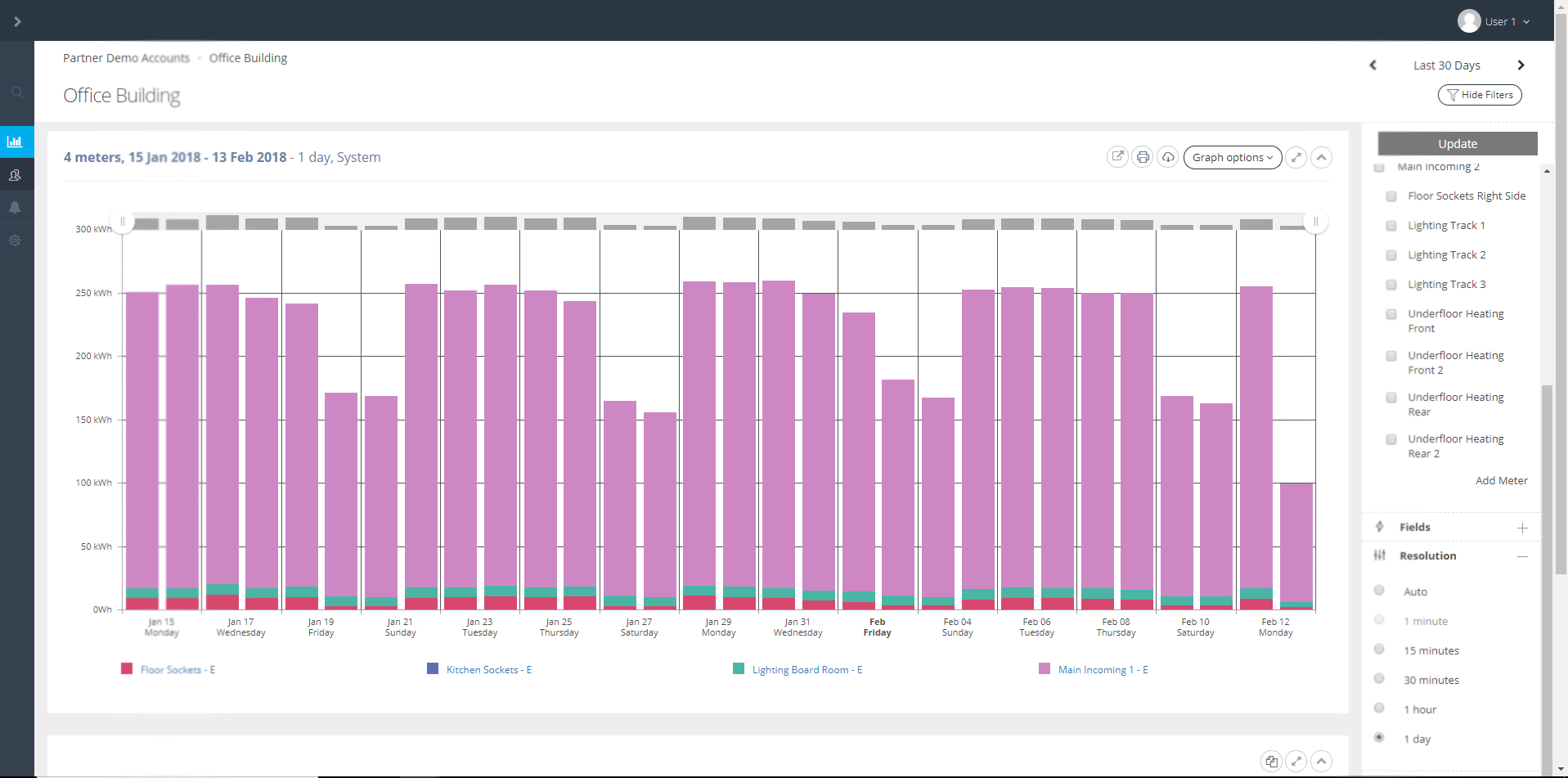 Behind every line of the bill there are specific circuits: a per-circuit breakdown shows which asset generates each dollar of the total.
Which tariff am I on: BTS, BTD, MTD? And which one suits me?
The acronym on your bill describes the voltage level (Baja/Media Tensión — low or medium voltage) and the metering type (Simple, with Demand, or time-of-use). BTS is low-voltage simple — typical of small premises, energy only. BTD adds a demand charge (kW). MTD is medium voltage with demand — common in industry — and time-of-use schemes price energy differently by hour of day.
Why it matters: tariff assignment is not optimized for you automatically. A facility can spend years on a tariff that does not match its real consumption profile. Comparing your measured profile against the available tariffs is one of the fastest savings there is — no capital required, just the right change request.
What is billed demand, and why do I pay for kW I “don’t use”?
Billed demand reflects the maximum demand your facility reached — your kW peak — not the energy you consumed. The utility sizes its network for your peak and charges you for it every month; under some schemes, past months’ peaks set the reference.
The practical consequence: a single simultaneous equipment start-up can fix your billed demand for months. Staggering start-ups, moving loads off-peak and watching the peak with continuous measurement cuts this line without touching production. It is exactly the kind of finding circuit-level monitoring exposes in the first week.
What is the power factor surcharge?
If your average power factor is below 0.90, the utility applies a reactive-energy surcharge under the SIE (electricity regulator) rules. Power factor measures how “efficiently” your equipment uses electricity: motors, compressors and HVAC naturally degrade it.
The good news: it is the easiest charge to eliminate entirely. A correctly sized capacitor bank — no more, no less — corrects it, and the project typically pays back in months. The key is sizing it from real measurements, not rules of thumb: a badly sized bank creates new problems.
How do I know if my bill has errors?
Errors exist and repeat: estimated instead of actual readings, billed demand that does not match the measured peak, tariffs left unadjusted after a load change, and surcharges that persist after the cause was fixed. The only way to catch them is to check the bill against your own independent measurement.
That is why every Boost engagement starts the same way: the free utility bill review. With your bill in hand we verify tariff, demand, power factor and errors — and tell you, in business language, how much money is on the table.
Frequently asked questions
Can I change tariffs myself?
The change is requested from your utility, but do it with data: the wrong choice can make the bill more expensive. Measure your real consumption and demand profile for at least one full cycle and simulate each available tariff before deciding.
Does the power factor surcharge always appear on the bill?
Only when your average power factor for the period falls below 0.90. If your facility runs many motors or air conditioners and has never corrected power factor, you are very likely paying it — look for “energía reactiva” or an FP surcharge line.
What does Boost need to review my bill?
Just the bill (PDF or photo) for the last 1-3 months. The initial review is free, with no commitment, and you receive a written diagnosis: tariff, demand, power factor and visible opportunities.
What size of operation is this service for?
We work with commercial and industrial operations whose electricity spend starts at roughly US$100,000 a year: plants, hotels, office campuses, retail chains, hospitals. At that bill size, circuit-level measurement and IPMVP verification pay for themselves; below it, honestly, we are not your best option.
Apply this to your own bill
Send us your bill and receive the free diagnosis: tariff, billed demand, power factor and errors, in writing.